

Advanced Search
Results 2241 - 2260 of 2291
LD2426F
LL7810A-S / LL7810D-S
LL7910A-S / LL7910D-S
THH102
When High-Performance Film Structures Begin with the Right Resin
When High-Performance Film Structures Begin with the Right Resin Selection
In recent years, the role of flexible packaging has evolved far beyond simply “wrapping products.” Today, it has become a key element in shaping consumer experience — from convenience and food safety to brand perception. At the same time, manufacturers are under increasing pressure to develop packaging solutions that meet stricter environmental standards while improving product performance to align with modern market demands.
Lamination film is one of the most critical components in flexible packaging. It is designed as a multilayer structure, where each layer serves a different function — whether supporting high-quality printing, enhancing packaging strength, or preserving product quality. Behind every layer lies one essential factor: selecting the right plastic resin for the right application.
.png)
One Film Structure, Multiple Functional Layers
Lamination films used in food packaging, snack pouches, and refill packs are typically not single-layer materials. Instead, they are multilayer structures engineered so that each layer performs a specific role.
For example:
- The Printing Layer should support high-quality graphics and dimensional stability.
- The Sealant Layer should provide reliable sealing performance to protect product integrity.
A clear example can be seen in snack packaging, where multilayer film structures help maintain crispness, prevent moisture penetration, and create attractive shelf appearance. If the printing layer lacks sufficient stability, graphics may become distorted or blurred. Conversely, if the sealant layer performs poorly, the product may lose quality before reaching consumers.
Performance Starts with Choosing the “Right Resin for the Right Function”
Selecting plastic resin is not simply about choosing the “best” material, but rather the “most suitable” material for each layer of the film structure.
For the printing layer, manufacturers require materials with excellent stiffness and dimensional stability to support technologies such as MDOPE (Machine Direction Oriented Polyethylene), which is gaining popularity as an alternative to conventional multi-material film structures. Since traditional multi-material structures combine different types of plastics, they are often difficult to recycle. Meanwhile, the sealant layer requires completely different properties. It must provide excellent low-temperature sealing performance, high toughness, strong impact resistance. These characteristics help improve production efficiency, increase machine speed, and reduce sealing defects during processing.
GC’s Role in Developing Lamination Film Solutions
GC has developed high-quality plastic resins under the InnoPlus by GC brand to support real-world applications across different layers of lamination films.
mPE & HDPE Resins for Printing Layer Applications
mPE and HDPE grades help enhance film strength and printability, making them suitable for both MDOPE and non-oriented PE film structures.
Recommended InnoPlus by GC grades:
mPE: LL7810 series, LL7820 series, LL7910 series, LL7905AM, LL7905AO
HDPE: HD4000F
LDPE, LLDPE, and mPE Resins for Sealant Layer Applications
LDPE, LLDPE, and mPE grades are designed to achieve excellent sealing performance at temperatures as low as 90°C*, while providing high toughness, clarity, and durability. These properties also support downgauging, helping reduce overall resin consumption.
*SIT testing condition: 2 bar, 1 sec
Recommended InnoPlus by GC grades:
LDPE: LD2426H, LD2426K
LLDPE: LL7410A / D1 / G1 / D / D2, LL7610A
mPE: LL7810 series, LL7905AM, LL7905AO, LL7810AW
These developments are not merely about enhancing material properties. They also help manufacturers improve actual production efficiency. For instance, lower sealing temperatures directly contribute to reduced energy consumption and enable higher machine operating speeds.
When “Thinner” Becomes a Competitive Advantage
One of the most significant trends in the packaging industry today is Downgauging — reducing film thickness while maintaining or even improving performance. This has become a key strategy for lowering costs and reducing environmental impact.
GC’s resins, engineered with high strength and toughness, play an important role in enabling downgauging without compromising packaging quality.
Advancing Toward Truly Recyclable Packaging
Today, one of the industry’s most important goals is designing packaging that can be effectively recycled. This has accelerated the adoption of Mono-material Packaging, where packaging structures use only one type of material — such as all-PE structures — to simplify recycling processes without sacrificing performance.
Organizations across the flexible packaging value chain, such as CEFLEX, have clearly emphasized that reducing material diversity within film structures can significantly improve recyclability rates.
GC’s PE resins, which can be used in both printing and sealant layers, enable manufacturers to more easily design mono-material film structures. This not only helps reduce environmental impact but also supports global brand owners striving toward 100% recyclable packaging goals.
More Than Plastic Resins — A Complete Solution Partner
What differentiates GC is not only its broad product portfolio that supports both performance and sustainability — including downgauging and recyclability — but also its role as a strategic partner helping customers design complete packaging solutions.
From film formulation development and laboratory testing to connecting stakeholders across the packaging value chain, GC works collaboratively with customers from upstream to downstream processes.
In today’s market, competitiveness is no longer defined by price alone. Adaptability, innovation, and sustainability are equally important. GC therefore positions itself not merely as a resin producer, but as a partner helping shape the future of high-performance and sustainable packaging.
Selecting the right plastic resin for lamination film may appear to be a small detail in the manufacturing process, but in reality, it is the starting point of everything — from product quality and production cost to environmental impact.
As the world moves toward sustainability, manufacturers that can select materials strategically — and collaborate with partners who understand both technology and market dynamics — will gain long-term competitive advantages.
This is the role GC continues to drive within the packaging industry, supporting packaging manufacturers in achieving sustainable growth together.
________________________________________
References
1. Amcor. (2026). Amcor External Decarbonization Roadmap,
https://assets.ctfassets.net/f7tuyt85vtoa/6gh2glZGtgnSL2jqSI6Bjr/90b21898e43916d84e5adf1887ca35d3/Amcor_External_Decarbonization_Roadmap_Updated_March_2026.pdf
2. CEFLEX. (ม.ป.ป.). CEFLEX Designing for a Circular Economy Guidelines,
https://guidelines.ceflex.eu
LL7810A-S / LL7810D-S
LL7910A-S / LL7910D-S
HD6900B
Getting To Know Plastic Packaging in Daily Life
.png)
Did you know ? “Most of the plastic packaging we use in our daily lives is made of from PE and PP”
The plastic resins are behind the quality, durability, and safety of everyday products.
PE (Polyethylene) – Produced from Ethylene, offers toughness, durability, chemical resistance, flexibility and excellent low temperature resistance.
Suitable for:
-Shopping bags / Zip-lock bags / Stand-up pouches
-Wrapping film/ Shampoo bottles / Home and personal care bottles / Jerry cans
PP (Polypropylene) – Produced from Propylene, offers toughness, chemical resistance, excellent high temperature resistance, and high stiffness.
Suitable for:
-Instant noodle cups lidding films / Beverage cups / Hot food bags (Curry bags) / Ready-to-eat food packaging / Saline bottles
Helpful tip: Look for the recycling symbol at the bottom of packaging, such as
02 (HDPE), 04 (LDPE), 05 (PP)
This will help you choosing the right material for each product and better understanding the materials used.
GC is a resin producer who behind a success of high-quality packaging, through the innovative development and production of high-quality PE resins—empowering manufacturers to create durable, safe, and well-suited packaging that confidently meets the needs of daily life.
Interested in PE plastic resin solutions, please contact : https://bit.ly/3wRUU1O
#GCPolymerSolution #เม็ดพลาสติก #PE
High-quality packaging starts with material you can trust
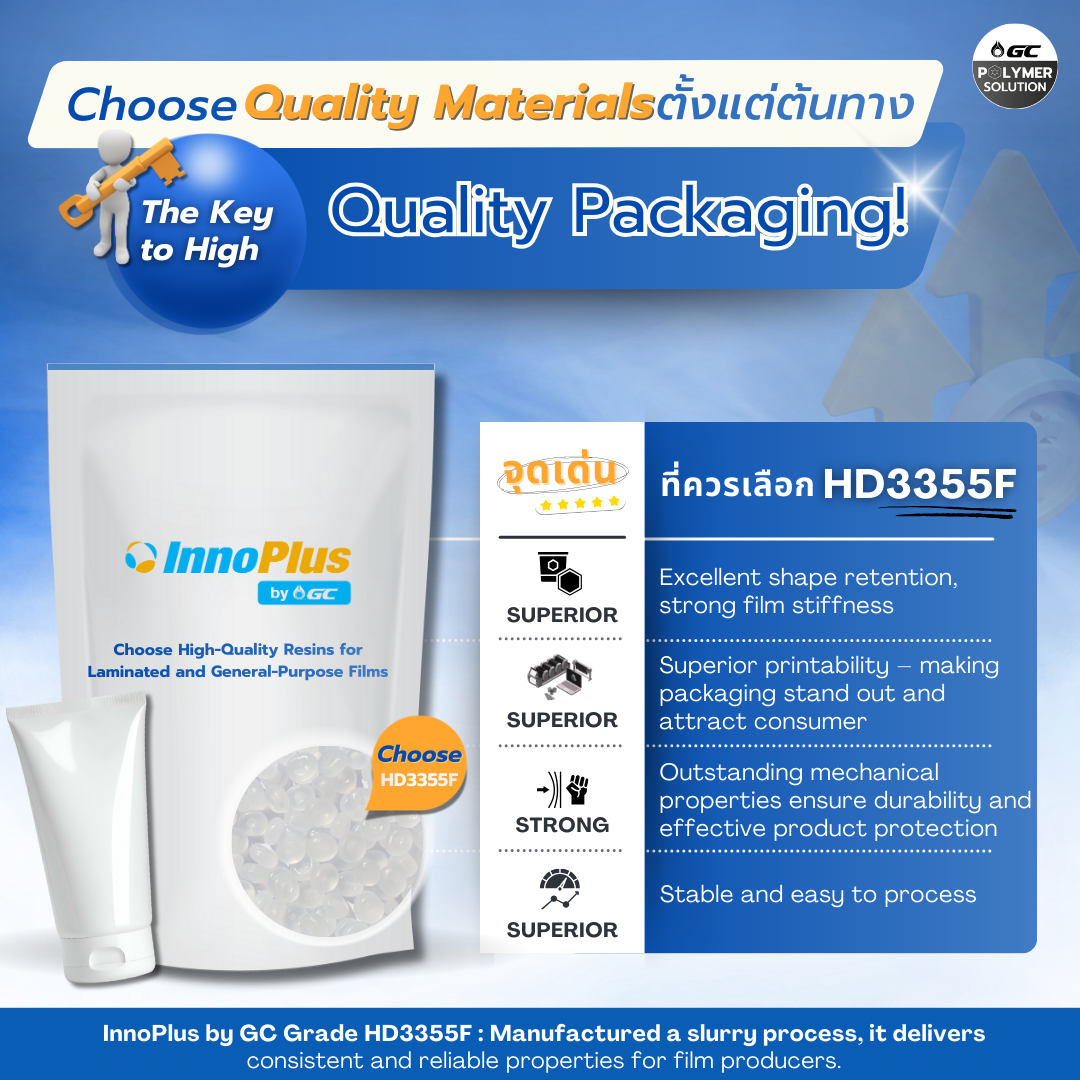
✅ Choose Quality Materials from the Start… The Key to Premium Packaging!
Modern plastic packaging must be strong, safe, and visually appealing. Selecting high-quality plastic resins is the first step to ensuring films and packaging perform at their best.
? InnoPlus by GC Grade HD3355F: A high-quality resin designed for producing laminated films and general-purpose films. Manufactured through a slurry process, it delivers consistent and reliable properties for film producers.
Why Manufacturers and Brands Should Choose HD3355F
✔️ Superior: Provides excellent shape retention, strong film stiffness, and superior printability — making packaging stand out and attract consumers.
✔️ Strong: Outstanding mechanical properties ensure durability and effective product protection.
Production-Friendly
Stable and easy to process, HD3355F is optimized for laminated and general-purpose films, reducing production issues and ensuring consistent quality across every batch.
InnoPlus by GC HD3355F is more than just a resin — it’s a solution to elevate flexible packaging quality. It helps create pouches that look great, stay strong, and build long-term trust for your brand.
GC : Total Solution Provider where Innovation Meets Sustainability
?สนใจนวัตกรรมเม็ดพลาสติกสำหรับผลิตฟิล์มบรรจุภัณฑ์ติดต่อ https://bit.ly/3wRUU1O
#GC #GCPolymerSolution #InnoPlusbyGC
New Product Innovation PE WAX
.png) The same wax you put in your hair?
The same wax you put in your hair?
Click here to find out!
PE Wax (Polyethylene Wax) is a synthetic wax in the polyolefin family (Polyolefin Synthetic Wax) which is highlighted by its excellent lubrication and dispersion properties.
PE Wax from InnoPlus by GC is available in both powder and flake forms. It is a by-product of the HDPE production process that meets international standards. Furthermore, it helps reduce waste, save energy, and enhance efficiency in the production process, aligning with the Circular Economy concept.
Distinct properties make production easier:
Good Lubrication: Reduces friction.
Beautiful Workpiece: Aids in the excellent dispersion of pigments/additives.
Reduced Production Costs: Lowers energy consumption during forming.
High Melting Point: Does not easily lose quality.
Versatile Applications: Used in both Masterbatch and PVC.
Recommended PE Wax grades: NW1004P, NW1030F, and NW1080F
Interested in PE Wax, contact us ! https://bit.ly/3wRUU1O
For more information : https://productsandsolutions.pttgcgroup.com/.../empowerin...
#GC #GCPolymerSolution #PEWax
Effective SHUT DOWN & START UP with X PURGC
.png)
Get Ready for the New Year Shutdown with Confidence!
As the long holiday approaches, make sure your machines are prepared for a smooth Shut Down and Start Up.
Plan ahead and order X PURGE by GC, the high-performance purging compound that ensures hassle-free machine restart after the break.
Why Choose X PURGE by GC?
X PURGE is not just an ordinary purging compound—it’s engineered for superior machine sealing during downtime.
Heat-resistant for excellent sealing performance
Reduces burnt residue build-up
Prevents common start-up issues after long breaks
Compatible with both Injection and Extrusion machines
Works with multiple resins: PE, PP, PVC, ABS, PET
Why Does Machine Sealing Matter?
✅ Prevents plastic from burning inside the barrel and screw, which causes black spots and defects
✅ Reduces residue build-up, making cleaning easier
✅ Protects and extends machine lifespan
Simple Steps to Use X PURGE by GC
1️⃣ Shut Down: Fill the machine barrel with X PURGE before turning off the machine
2️⃣ Start Up: Gradually raise the temperature and safely purge X PURGE before resuming production
Key Benefits You Can’t Miss
✅ Saves time and simplifies cleaning procedures
✅ Reduces defect risk and improves product quality
✅ Easy to use, safe, and equipment lifespan extension
✅ Excellent heat resistance for effective machine sealing
✅ Makes screw removal and cleaning much easier
Don’t let small issues disrupt your production after the holidays.
Choose X PURGE by GC for confidence in every start-up!
GC: Total Solution Provider where Innovation Meets Sustainability
https://bit.ly/3wRUU1O
Superior Protection Against UV & Chemicals Built to Resist. Designed to Last.
.png)
?️ Superior Protection Against UV & Chemicals Built to Resist. Designed to Last.
“InnoPlus by GC HD7808B” is a high-quality HDPE resin specially developed for IBC tanks and large containers in heavy-duty and outdoor condition.
Superior Performance Features :
✅ Impact Resistance
✅ Excellent ESCR
✅ UV Stabilization
✅ Long‑lasting Performance
Suitable for applications :
The storage and transportation for liquids and semi-liquids, such as IBC tanks, water tanks, chemicals, and edible oils.
Solution for manufacturers seeking durability, safety, and processing efficiency in a single material.
? https://lin.ee/n1ekdJvFor more information or product inquiries, please contact us.
#GCChemistryforBetterLiving #GCPolymerSolution #InnoPlusbyGC #HDPE #IBCTank #เม็ดพลาสติก #HD7808B
A Great Cap Starts with High-Quality Resin – InnoPlus by GC HDPE Grade HD2200JP
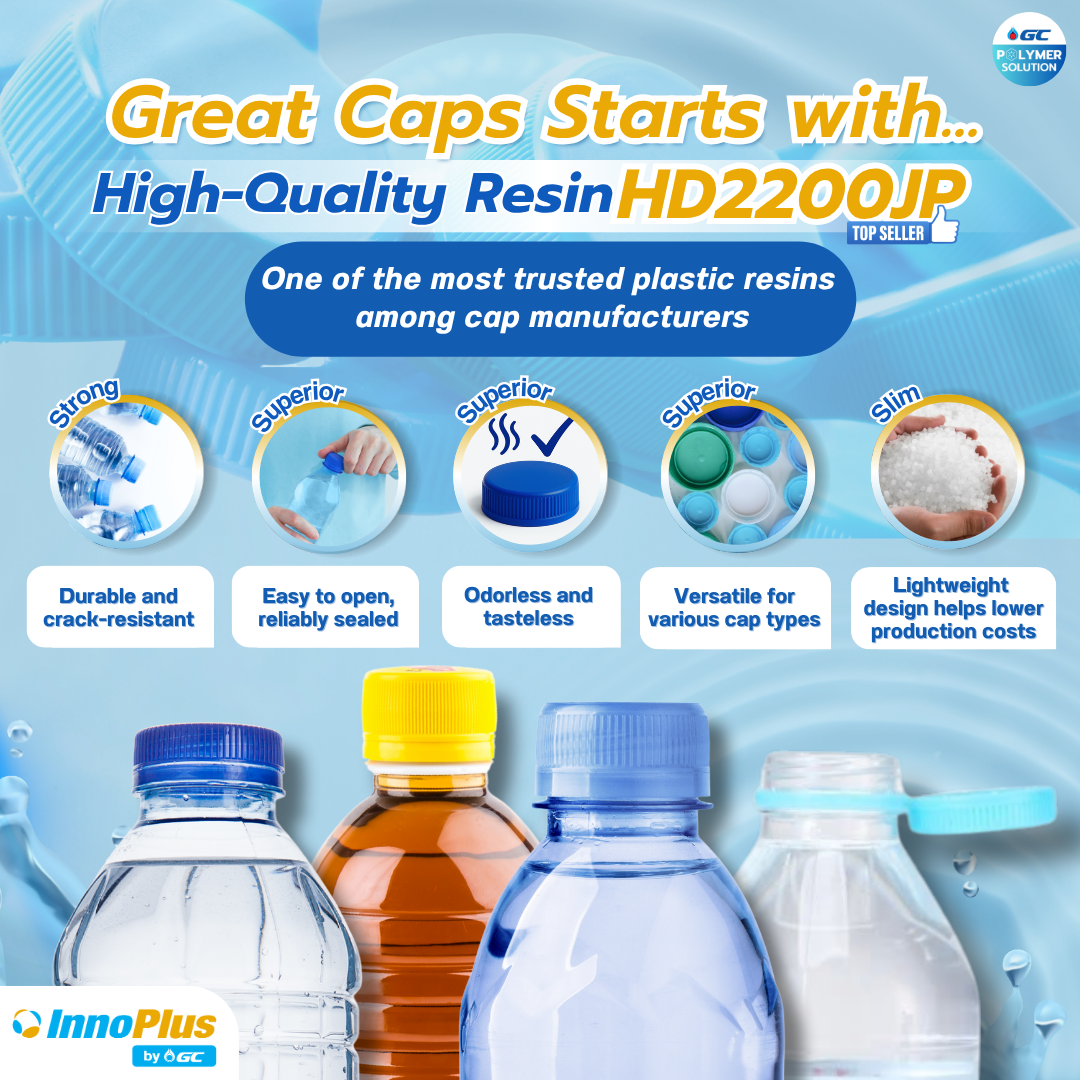
A Great Cap Starts with High-Quality Resin – InnoPlus by GC HDPE Grade HD2200JP
Behind the satisfying experience of opening a bottle of water, tea, or your favoritechilled drink, there’s one thing in common – the plastic resin used to make the cap.That’s where InnoPlus by GC – HDPE Grade HD2200JP comes in.
Why is HD2200JP ideal for non-carbonated beverage caps?
- Strong: Exceptional strength and resistance to torque and compression, reducing therisk of leaks or cracks—even during long-distance transport.
- Superior: Balanced opening torque for easy opening and secure closure. Compatiblewith short-neck caps, tall caps, and tethered cap designs.
- Superior: Passed organoleptic testing to ensure no effect on the taste or smell ofbeverages.
- Superior: Suitable for both injection and compression molding, enabling diverse capdesigns—for beverages e.g. water and tea to juice, coffee, and healthy drinks.
- Slim: Lightweight for reduced resin usage per cap, while maintaining premium quality.
? Choose HD2200JP – high-quality plastic resin you can trust for bottle caps every day.?
Power That Floats – With the Strength of InnoPlus by GC HD8200B
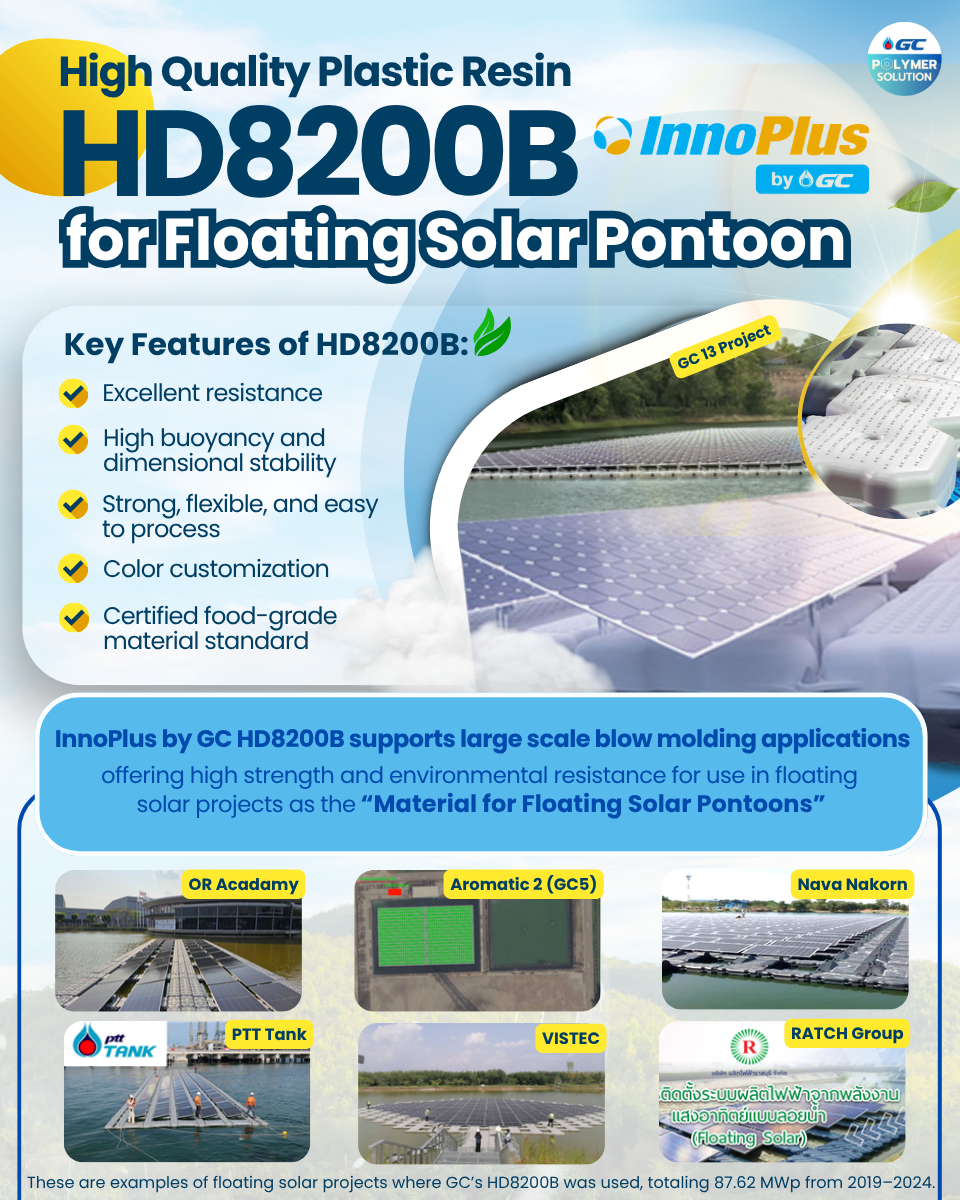 Power That Floats – With the Strength of InnoPlus by GCHD8200B
As the global shift toward clean energy accelerates, Floating Solar Pontoon technologyhas emerged as a vital solution for the industrial and renewable energy sectors.
InnoPlus by GC HD8200B is specially developed to support large blow moldingapplications, offering exceptional strength, durability, and resistance to environmentalconditions—making it the ideal material for manufacturing pontoons in floating solarpower projects.
Ideal for:
Manufacturers of floating solar pontoons
Large blow molding producers requiring high strength and durability
Operators seeking safe plastic resins with specialized properties for outdoor use
GC has pioneered the development of pontoon-grade materials for floating solarpower generation, gaining recognition across multiple projects with a total powergeneration capacity of 87.62 MW between 2019 and 2024.
Key Features
Excellent resistance to environmental conditions and chemicals
High buoyancy and dimensional stability to support weight effectively
Strong, flexible, and easy to process
Color customization to match project requirements
Certified food-grade material standard
From InnoPlus by GC Resin to High-Quality Stretch Film.
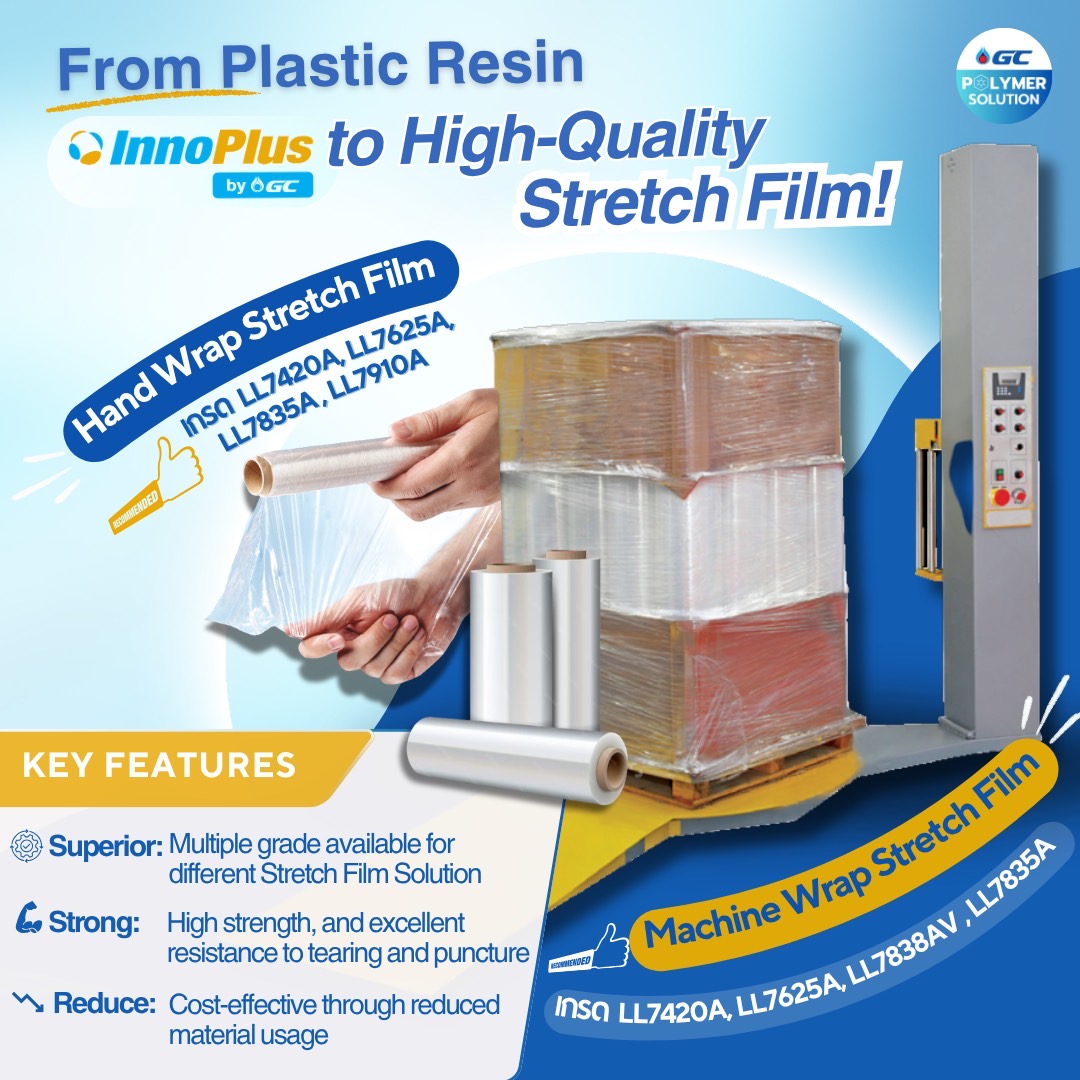
From InnoPlus by GC Resin to High-Quality Stretch Film.
Stretch film is a widely used packaging solution across various industries. Known for itstoughness, clarity, high stretchability, and self-adhesive properties without requiring heat, stretchfilm is ideal for wrapping, protecting, and securing goods during transportation and storage—whilehelping reduce overall packaging costs.
GC has developed InnoPlus by GC, a premium polyethylene (PE) resin designed for high-performance stretch film production. Suitable for both hand wrap and machine wrap applications,InnoPlus by GC offers a range of PE resin grades customized for diverse application needs, asfollows:
✅ Superior:
Offers a variety of grades for Stretch Film Solutions, supporting and meeting the needs of high-quality stretch film production. Options include Linear Low-Density Polyethylene C4-LLDPE:LL7420A, C6-LLDPE: LL7625A and Metallocene Linear Low-Density Polyethylene (mLLDPE):LL7835A, LL7838AV, LL7910A
Recommended Grades:
• For Hand Wrap: LL7420A, LL7625A, LL7835A, LL7910A
• For Machine Wrap: LL7420A, LL7625A, LL7838AV, LL7835A
✅ Strong:
Enhances film strength, toughness, and resistance to tearing and punctures, protecting productsfrom damage. Especially suitable for applications requiring high strength, such as machine palletwrapping.
Recommended mLLDPE Grades: LL7838AV and LL7835A
✅ Reduce:
Enables film downgauging (thinner films), reducing material use and production cost whilemaintaining performance.
Recommended mLLDPE Grades:
• For Hand Wrap: LL7910A
• For Machine Wrap: LL7838AV
Revolutionizing Flexible Packaging with HD4000F – Truly Sustainable Innovation
.png)
Revolutionizing Flexible Packaging with HD4000F – Truly Sustainable Innovation
HDPE grade HD4000F from InnoPlus by GC brand is plastic resin ideal for Blown Film Extrusion and Oriented Film processes, as well as packaging that requires form stability and heat resistance. Formulations using HD4000F can be used as substitute for BOPA and BOPET, making them 100% recyclable while maintaining both strength and aesthetics.
Sustainably Different – 3 Key Features of InnoPlus by GC: HD4000F
- Superior: Easy processing and excellent formability
Strong: High stiffness and heat resistance
Recyclable: recyclable and reduces greenhouse gas emissions
GC: Total Solution Provider where Innovation Meets Sustainability
For more information or to request plastic resin samples, please contact us at ? https://bit.ly/3wRUU1O
Industrial Packaging Trends: IBC by InnoPlus HD7808B by GC
Industrial Packaging Trends: Stronger, Long-Lasting, and More Reliable with InnoPlus HD7808B by GC
Today’s industrial packaging manufacturers face increasing demands for greater impact resistance, superior chemical durability, outdoor performance, and consistent product quality throughout the packaging lifecycle.
Intermediate Bulk Container, or IBC, is designed for practical use in a variety of industries which required safety in storage and transportation of goods, as well as confidence in the quality of packaging throughout its lifetime.
InnoPlus HD7808B by GC has been specially developed to deliver an optimal balance of mechanical strength, chemical resistance, and processing performance. It enables manufacturers to produce high-quality IBC tanks that meets industrial standards.
.png)
Why Choose InnoPlus HD7808B?
InnoPlus HD7808B is designed to enhance the performance of IBC tanks as well as large industrial containers across 4 key factors:
1. Superior Strength and Impact Resistance
Suitable for containers that need to be transported, stored and used in industrial environments
2. Outstanding Chemical Resistance and Crack Prevention
With its outstanding ESCR properties, it enhances the reliability of IBC tanks when exposed to chemicals and challenging operating conditions, reducing the risk of premature failure.
3. Reliable Outdoor Performance
With UV stabilization helps enhance product durability against sunlight and outdoor weather conditions.
4. Long-Term Stability and Consistent Quality
Enhance IBC tanks and large industrial containers maintain their structural integrity and consistent performance throughout their service life.
Solution for Manufacturers, Traders, and Brand Owners
InnoPlus HD7808B is a reliable material solution for converters, traders, and brand owners seeking high-performance resin for large industrial packaging applications, particularly IBC tanks that require exceptional strength, safety, and durability.
With properties that meet the needs of both applications and production, HD7808B is an option that support next-generation industrial packaging to be able to deliver quality, reliable products and confidently meet market