

Advanced Search
Results 1401 - 1420 of 2291
GC Participates in ECO event – Shine Glow Plastic Party 2025
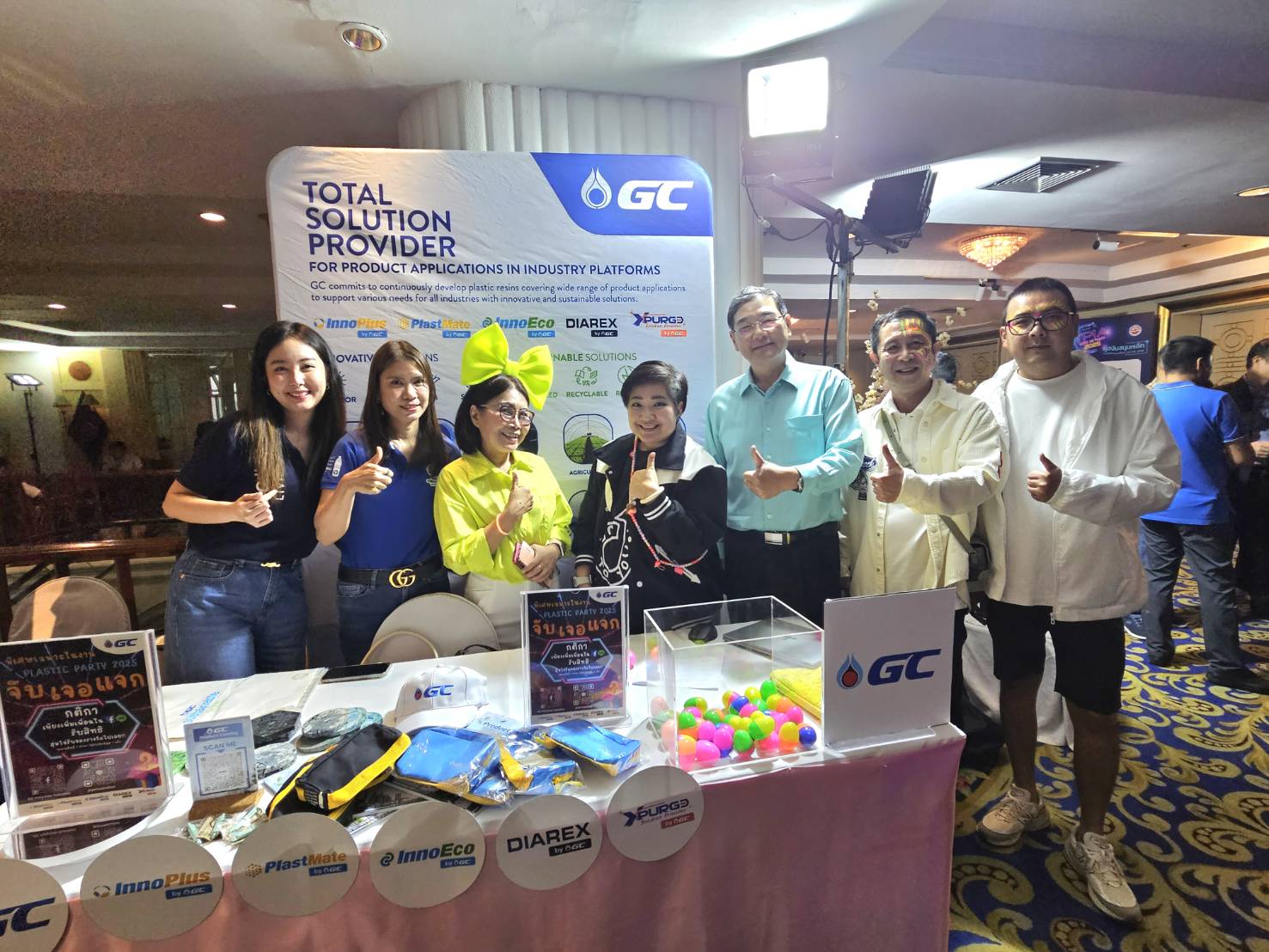
February 22, 2025: GC hosted activity booth to promote GC Product Brands to plastic industry entrepreneurs at the ECO – Shine Glow Plastic Party 2025, organized by the Thai Plastics Industry Association. The PLASTIC PARTY 2025 is annual event held by the Association to provide platform for members and entrepreneurs in the plastic industry to network and socialize. GC participated in the event and organized "Catch, Find, Give" game booth to increase awareness of GC's Product Brands among members and plastic entrepreneurs, following the addition of "by GC" to the logo since 2024.
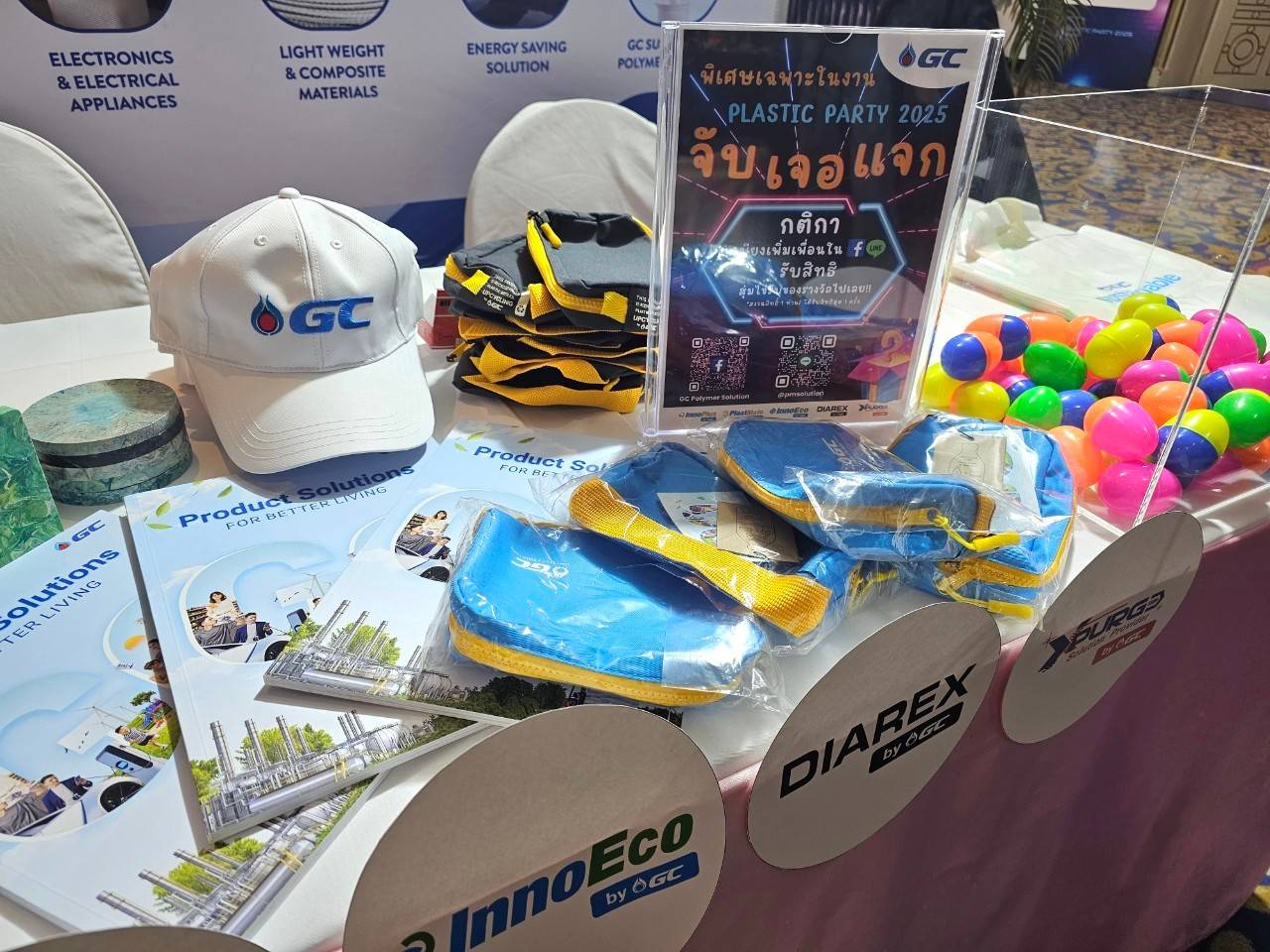
GC's Product Brands promoted at the event included:
- InnoPlus by GC: For polyethylene and polyethylene terephthalate plastic resins, including HDPE, LLDPE, mLLDPE, LDPE, and PET.
- PlastMate by GC: For various types of compound plastic resins, such as PE compound, PP compound, PS compound, PC compound, ABS compound, and Bioplastics Compound.
- InnoEco by GC: For high-quality recycled plastic resins (Post-Consumer Recycled), including PCR PET, PCR HDPE, and PCR Compound.
- DIAREX by GC: For general-purpose polystyrene (GPPS) and high-impact polystyrene (HIPS) plastic resins.
- X PURGE by GC: For compound plastic resins used for cleaning cylinders and screws, or machine cleaning pellets, which quickly remove contaminants from machinery without disassembly, reducing machine downtime and increasing production capacity.
Many entrepreneurs attended the event and followed news and information about chemical and plastic-related products, technologies, and innovations from GC through various channels.
Facebook: https://www.facebook.com/profile.php?id=61556393516003&locale=th_TH
Line Official Account: @pmsolution
GC organized an online seminar on “The Future of the EV Market in Thailand: Opportunities, Directions, and Challenges”
.png)
February 27, 2025: PTT Global Chemical Public Company Limited, or GC, hosted an online seminar titled “The Future of the EV Market in Thailand: Opportunities, Directions, and Challenges.” The event aimed to share insights on the trends in Thailand’s EV automotive industry, while also introducing innovative GC Group materials used in the manufacturing of automotive parts. The goal was to help customers and partners prepare their businesses, adjust strategies in line with changes, and boost competitiveness.
The seminar featured expert speakers:
1. Mr. Winyoo Laowattana, Committee Member and Vice Chairman of WG3 on Policy, Standards, and Industry Transition, Electric Vehicle Association of Thailand.
2. Mr. Taweesak Kaoson, Marketing Director, Asia Pacific at Allnex (Thailand) Co., Ltd.
3. Mr. Panat Jiitiapon, Application Engineer of Construction Platform at PT Global Chemical Public Company Limited.
During the seminar, the speaker from the Electric Vehicle Association of Thailand discussed global trends in the EV industry and their impact on the Thai market, including an overview of investments by foreign EV manufacturers in Thailand. While, the speaker from Allnex (Thailand) introduced “Coating Innovation,” a chemical coating product known for its effectiveness and durability in producing various automotive parts.
The session concluded with a presentation by GC, which detailed the end-to-end development process for plastic resins—from design and formula development to laboratory and application testing. This makes InnoPlus by GC, PlastMate by GC and InnoEco by GC are ideal for manufacturing both exterior and interior automotive parts. In addition, GC introduced X PURGE by GC, mechanical purging compound that improves machine efficiency, reduces cleaning time, and minimizes waste during production, ultimately lowering manufacturing costs for manufacturers.
GC believes that the knowledge and innovations shared in this seminar will be supportive driver for our customers and business partners in developing effective strategies and preparing for future sustainable business.
4S & 4R: Key Innovations and Sustainability Features of GC’s Plastic R
.png)
GC is the leading plastic resin manufacturer in Thailand, committed to develop products that serve diverse industry needs. With a strong focus on innovation (4S) and sustainability (4R), GC utilizes advanced production processes in plastic resin plants and recycled plastic resin plant to deliver high-quality products that ensure both efficiency and environmental responsibility.
Understanding the 4S & 4R principles allows customers and business partners to select the most suitable GC products to create solutions that align with both innovation and sustainability goals.
.png)
Innovation (4S)
Superior
- Enhanced production efficiency (Superior Processability)
- Increased yield and reduced waste (Yield Increase / Loss Reduction)
- Outstanding appearance e.g.superior printability and adhesion (Superior Appearance)
Strong
- High Strength
- High Barrier
Slim
- Light Weight
- Easy to Use and Transport
Saving
- Energy Saving
- Total Cost Saving
Sustainability (4R)
Reduce
- Downgauging to minimize material usage
- Less plastic consumption
Recyclable
- Mono-material for easier recycling
Recycle
- Post-Consumer Recycled Resin (PCR)
Renewable
- Bioplastic Resin
GC organized online seminar on "China's Economy 2025: Can it fight Trump 2.0?"
.png)
January 30, 2025, PTT Global Chemical Public Company Limited (GC) held the online seminar in "China's Economy 2025: Can it fight Trump 2.0?" to educate and strengthen understanding for customers and partners that are Plastic resin manufacturers in Thailand. This session provides information about the situation in the era of President Donald Trump's policy 2.0, which aims to open up new perspectives through data analysis, economic trends, and economic trends. China's trade changes and strategies on the world stage that is currently a trend of producers being alert to adapt and prepare for this situation. Therefore, this seminar receive a lot of attention from customers and business partners in all industries.
This seminar was honored by expert speakers, namely: Assoc. Prof. Dr. Aksornsri Phanishsarn , Lecturer at the Faculty of Economics, Thammasat University
The speaker gave the information about China's response to U.S. challenges more comprehensively as follows:
• Strategy: Launch of DeepSeek AI from China that is High-Performance and Low-Cost so it can be OpenAI's competitor
• China continues to diversify its export markets to the Global South.
Global South is ASEAN + South Asia +MENA (Middle East/North Africa) + Africa+ South America + Central Asia + Russia
*ASEAN has become China's No. 1 trading partner.
• China aims to strengthen its internal economic structure by building domestic consumption power and reducing dependence on foreign sectors. China reduced its dependence on the U.S. market to 14.8% of China's total exports (from over 20%).
Thus, plastic resin manufacturers in Thailand have to adapt to China and the United States in terms of exports is to reduce their excessive dependence on "foreign sectors" in terms of exports, which Thailand currently relies on exports to the US and China, and adopt the strategy of restructuring exports, upgrading products quality and focusing on the upper market to increase the value of products such as recycled plastic resins and bioplastic resins, etc.
GC Delivers World-Class Quality Plastic Resins with SNI Certification
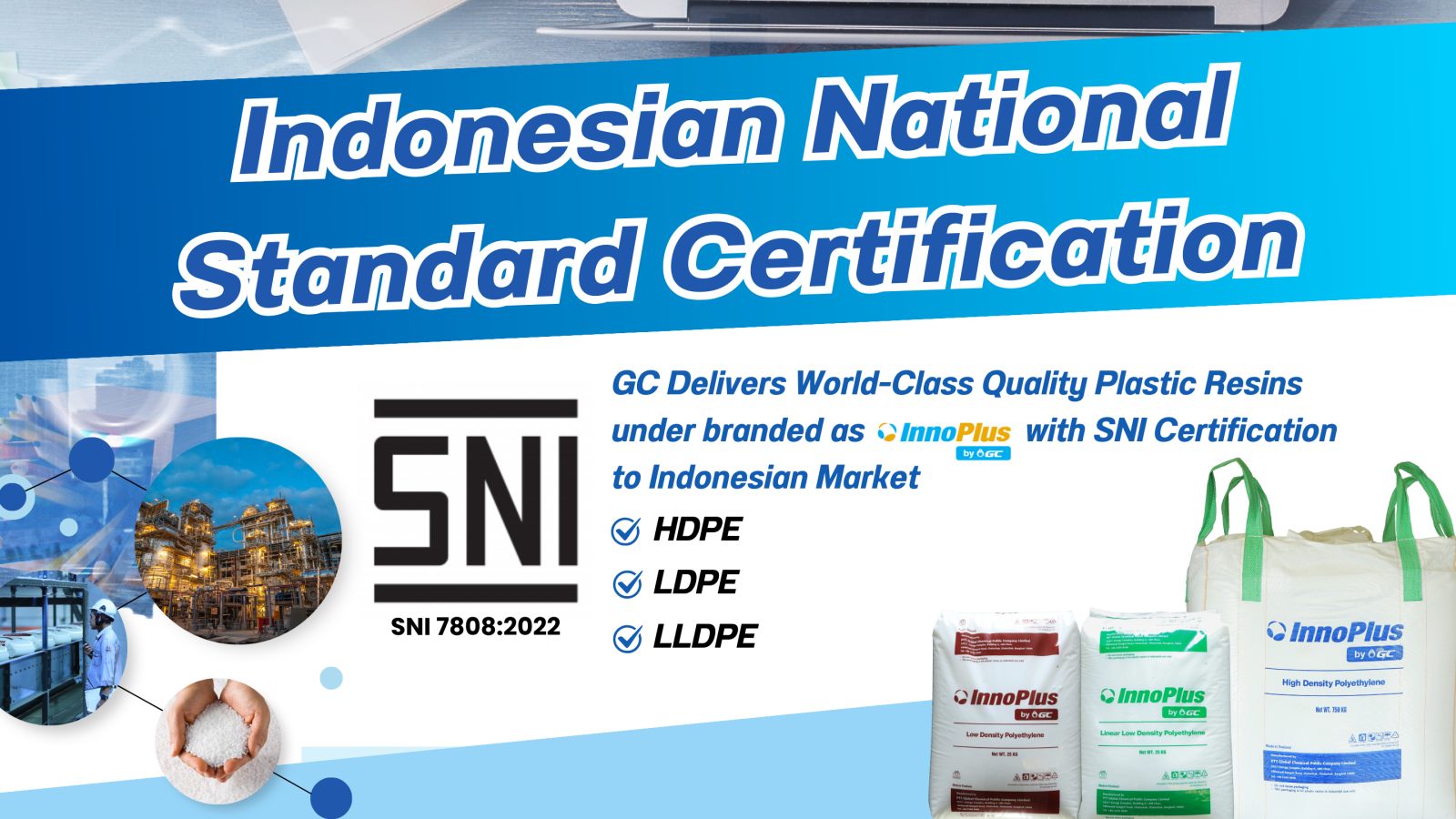
GC reaffirms its leadership in global plastic resin manufacturer by developing and manufacturing plastic resins under brand InnoPlus by GC internationally certified for quality. This reflects GC’s commitment to strict manufacturing standards and delivering high-performance, safe, and market-driven products.
InnoPlus by GC, a Major Milestone with certified SNI Standard in Indonesia
GC’s LLDPE, LDPE, and HDPE plastic resins have received SNI (Standard National Indonesia) certification, marking a significant step in expanding GC’s presence in the Indonesian market.
What is the SNI Standard?
SNI (Standard National Indonesia) is Indonesia’s national standard, issued by the Badan Standardisasi Nasional (BSN) to regulate product quality and safety within the country. Achieving SNI certification confirms that InnoPlus by GC is an internationally manufactured plastic resin brand that meets Indonesia’s stringent quality requirements. This certification process involves rigorous inspections covering the entire production chain, including GC’s manufacturing facilities, GC Lab Centre, and GC Innovation Centre.
ISO 9001 Certification: Ensuring Global Quality Standards
In addition to SNI certification, GC’s manufacturing facilities are also ISO 9001 certified, a globally recognized quality management system. This ensures that GC’s production processes meet international standards, with strict quality control at every stage and full traceability of products.
GC’s Commitment to a Sustainable Future
GC is dedicated not only to delivering world-class quality plastic resins but also to prioritizing safety, reliability, and environmental sustainability—building more sustainable future for both industry and society.
Source: https://sni-certification.com
Mono Material Plastic Innovations for Sustainability

Plastics continue to play an essential role in the production of consumer goods, packaging solutions, and automotive components, and their use is expected to grow steadily. Among the emerging innovations that reflect today’s environmental priorities is Mono Plastic, also known as Mono Material. This concept focuses on using a single plastic type to manufacture products or packaging, making them significantly easier to recycle and more environmentally friendly.
What is Mono Material?
Mono Material, or Mono Plastic, refers to the use of only one type of plastic resin throughout the entire production process of a product or packaging. By eliminating the need to combine multiple plastic types, mono material reduces the complexity associated with recycling multi-layer or mixed-material plastics. As a result, recycling becomes more efficient, and long-term environmental impacts are reduced.
Mono Material: An Eco-friendly Plastic Innovation
Plastic waste recycling today remains highly challenging. Different plastic types must be carefully separated—a labor-intensive and resource-heavy process. This complexity drives up the cost of producing recycled plastic resins, making them more expensive than virgin plastics. Consequently, many manufacturers still choose landfilling over recycling, leading to large amounts of plastic waste remaining in the environment.
Mono Material provides a solution to this long-standing challenge. By using a single plastic type from start to finish, the material can be recycled much more easily, eliminating the need for complicated sorting. With advanced processing technologies, the functional properties of each resin type can still be preserved.
Key Advantages of Mono Material
Strength and Durability Despite being made from a single plastic type, mono material products can achieve excellent mechanical strength and durability. Modern manufacturing technologies allow them to perform on par with conventional materials composed of multiple plastic layers.
- Environmentally Friendly Production The production of mono material requires less energy and water compared with traditional plastic manufacturing methods. It also releases lower levels of carbon dioxide, helping curb global warming right from the production phase.
Easier to Recycle Mono material products can be sorted and recycled immediately without undergoing complex separation processes. This helps reduce the volume of waste sent to landfills.
Safe for Food Contact Mono material can be processed into food-grade packaging that meets the standards set by the Ministry of Public Health.

The Rising Trend of Mono Material Packaging
Mono Material Packaging not only reduces energy consumption and emissions during production but also overcomes many of the limitations traditionally associated with recycled plastics. It can be safely used for food and beverage applications, offering both convenience and consumer confidence. Moreover, its single-material design makes waste sorting significantly easier, allowing the packaging to be fully recycled instead of becoming “orphan plastic” destined for landfills.
The mono material trend is a strong complement to the principles of the Circular Economy, which emphasizes the efficient and sustainable use of natural resources through reuse and recycling. Packaging designed from a single plastic type ensures that materials can be collected, processed, and manufactured back into new products with maximum efficiency.
Adopting mono material not only benefits the environment and supports efforts to reduce plastic waste but also enhances business competitiveness. It helps lower production costs while building a positive corporate image, an important factor as today’s consumers increasingly prefer products from companies with strong environmental commitments and social responsibility.
For businesses seeking ways to reduce environmental impact and elevate their brand reputation, GC offers high-quality plastic resins developed through cutting-edge manufacturing technologies. Our innovations span petroleum, petrochemical, and chemical products—including premium polymer and resin solutions designed to deliver consistent performance and meet a wide range of application needs.
Reference
“Introduction to Mono Material for Flexible Packaging—An Eco-friendly Solution.” Accessed July 4, 2024, from https://productsandsolutions.pttgcgroup.com/th/blog/รู้จัก-mono-material-สำหรับผลิตซองบรรจุภัณฑ์-โซลูชั่นที่เป็นมิตรต่อสิ่งแวดล้อม